
There are two important things about finishing Bioshock
- My plan to finish games before moving onto the next is working
- I can do one of my first game breakdowns
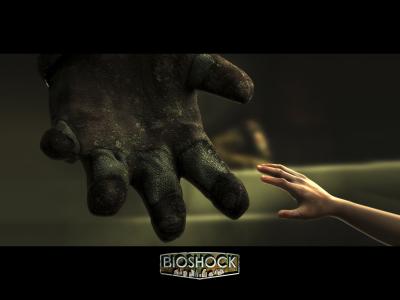
Bioshock is a fairly complicated game made out of simple pieces. I find that most games that I like, Bioshock being one of them, have a design that almost spells itself out to you as you play. Bioshock still leaves lots of flexibility and provides elemental pieces that the story leads to you. In this way, the progression in the game is kept interesting even though the classes of characters you fight is very limited.
Up unto this point there haven’t been and SPOILERS. If you don’t want any SPOILERS…please stop reading here.
<–SPOILERS SPOILERS SPOILERS SPOILERS SPOILERS SPOILERS SPOILERS–>
Story
The story in Bioshock took me a little to get into. For me the key to a good story in a game is to involve the character in nearly every game event. Bioshock really does base the story around you and the progression (I went good, saving all the little sisters) makes you feel involved. I wasn’t hooked until the midway point and I didn’t think the story came together at all until the last three levels. Overall the story arc of first being intimidated by the big daddies and then having to become one to defeat Fontaine was awesome. The key thing Bioshock has taught me about story telling is to build up relationships and questions at the beginning of the game and then turn both those relationships and the need to get answers on the player later.
I am always a sucker for games that have different endings. Even if I never watch them all myself, knowing they are there is a draw to a game for me. Must be the result of Wing Commander burning branching story into my mind as an early gamer.
Weapons
As a first person shooter, the interactions in the game are basically all with weapons and plasmids. The amount of selection is incredible. With about 6 weapons and at least 2-3 ammo types per gun there are up to eighteen options with guns. The ammo types are a great way to scale weapon firing types without having to model anything more from the gun. But then there were 5 weapons that could be upgraded as well! So the amount of customization is handled very nicely by just having a few additional visual meshes on the weapons.
Having a camera/research element was a great way to get the names of the creatures you face as well as making you realize that your opponents are different even if they look the same.
Plasmids are probably the most unique element of the game and they opened up some very interesting options. Much of the base elemental stuff like fire, freezing and electricity was shared with the ammo so you could get interesting shared effects that make implementing features like this much cheaper on the engineering side. The things that weren’t in weapons were story elements like the insect swarms and the hypnotize big daddy. In this way, nearly everything gets repeated use and can function as a weapon.
Taking over turrets and security bots was another great way to increase your firepower and play with different tactics.
Weapon design in this game was excellent and it was implemented in a way that made my engineering side smile. Everything is basically reused to maximum potential
- One weapon, many types of ammo: Less weapon models and more customization
- Elemental damage types (Melee, Fire, Freezing, Bullet, Anti-personnel, Armor piercing): lots of these damage types are reused either between plasmids and ammo types or they are used by the creatures in the game
Aiming is also a key thing Bioshock got right. They assist you more than most other games in three ways
- Projectile assistance: You don’t need to be pointing at your target, within a certain distance of the reticle it will shoot towards the closest enemy
- Crosshair following: After being on a character it will follow them even if you don’t with the controller, actually turning your view
- Crosshair glue: I’m not sure if this is the same as the above or not, but it seems like you get slowed down on your target.
The assistance they give makes this work as not only a twitch shooter, but it also works for RPG fans that don’t want all the precision aiming.
Character Upgrades
Outside of upgrading your weapons/plasmids, there were several things to enhance yourself with in three different categories. Having the upgrade system in the game not be point based and having it fit in with the game fiction was a very clever choice. I never felt removed from the world fiction when upgrading myself. The self gating of the slots by having to pay to open new ones was great to limit characters within the world fiction.
Enemies
There is a good selection of enemies. Something like 3-5 splicer variant models used to make up numerous classes of splicers. A few classes of big daddies. Security bots, turrets…and that is about it outside of boss battles. They make so much out of so little it is awesome.
Graphics
Many people marveled at how Bioshock looked and gave the engine credit. I do think that their engineers did a great job, but what really makes Bioshock shine is the consistent art direction and the delivery of those assets. In a game like this, and in most first person shooters, you need to spend more effort on the world than you do on the characters. The amount of style this game has is awesome. The world assets are all solid and reusing these assets never gets old. This game also paints a vibrant picture with lighting. I don’t think I have seen another game that can get away with using so many primary colors in lighting and not look completely fake or over the top.
Summary
I think that great games could run on any system and I think Bioshock could have been an interesting game as a side scrolling game. I don’t think it takes technical innovation to make great games anymore and I think Bioshock’s success is grounded in execution and substance, not technical flair.


 IGAMEMAKER.COM
The next “next generation” has its work cut out
I was thinking of how we are probably approaching another generation of hardware and wanted to share my thoughts on the topic.
The next generation is going to have an uphill battle to sustain growth rates if the industry focuses on the traditional hardcore gamer. Next generation systems are historically sold on graphical advances and we are reaching the point of diminishing returns. Disruptive technologies like the Wii interface or guitar hero are drawing more attention than consoles themselves. Consoles are also running out of “obvious” technical innovations to draw on from PC gaming. To be successful, I belive the next generation is going to have to wait longer and carefully target interface evolution.
People are generally focused on how good games look. The advances from the NES/SNES days to the current generation of hardware is staggering. You could watch the PC market to see what consoles would be getting a couple of years down the road. If that is true today, even though the growth rate of graphic card power is staggering, the visual advances no longer match. If you show your average consumer Crysis and Half-life 2 you will not get nearly the reaction as from Super Mario 3 to Mario World. The Half-life 2 engine is still being used for game four years after its release and they are competitive quality. Graphics cannot be the main selling point for a new generation of hardware and Wii has arguably proven that for this generation by the Wii.
Nintendo’s tactic with Wii has been a suprise success. Not taking part in the graphics war and instead focusing on control innovation proves that audiences are looking for something new. Disruptive technology really defines the game industries progress. Games like Guitar Hero hinted that this kind of innovation could sell not only peripherals, but consoles. With the exception of the interface technologies like Wii and Rock band, nearly every innovation for consoles was first explored on PC. Wolfenstien 3D was the original first person game and it was a huge leap to see through your character’s eyes. Another leap was with Doom which added height, lighting and multiplayer. Doom would not have been the sensation it became without the disruptive influence on business networks at the time. I’m focusing on the example of first person shooters because they are some of the highest profile games in the history of gaming and highlight the delay between PC delivery of features and consoles (COD4, Crysis, Halo, Halflife, DOOM etc.). The issue right now is that there is not currently a disruptive technology available on PCs to point to. There was always a logical massive evolution for consoles to grow into. Currently there is not an obvious example of where the next generation can evolve.
Without a leading market to see what the next big thing on consoles is, what hopes do we have for a new generation? The most exciting thing developing in PC hardware right now is the generalized GPU. They are coming full circle to being general processors. The CELL in the PS3 is similar in design and so will Intel’s larabee architecture. What this means from a technology perspective is that people will be able to apply the hardware in more unique ways to solving problems. Graphically this could lead to some major advancement and differences in how games look if people leverage this technology. This is a huge if, but we may see some advancement. New interfaces are also available, be it brain wave or further advancing accelerometers. I doubt that neural interfaces will take off in the near future given the amount of time it takes to train on them. Voice recognition and camera interfaces haven’t really taken off yet in games. Three dimensional displays may be a huge hit if both film and games can embrace and push the technology. The time line for change in the home TV market is roughly a 20 year turn around if you use high definition as a format example. If none of these changes appear big enough to warrant a new wave of next generation, what should the industry do?
Going forward, the industry should focus on software sales from the current generation and extend the life time of this hardware cycle. Look at the longevity of the PS2 and how great some of the games late in the life cycle were. Will this happen? No, I actually predict that Microsoft will be on a four year cycle again and I believe we will see game quality drop for another year or two when games could innovate and advance with current hardware and the online space for another couple of years. For the gamer in me, I actually hope this console generation targets a seven year run. Even the technologist in me wants to see architectures like Larabee for a year or two on PC before they are on consoles. I guess we will find out in the next two years.